Toute connaissance que n’a pas précédé une sensation m’est inutile
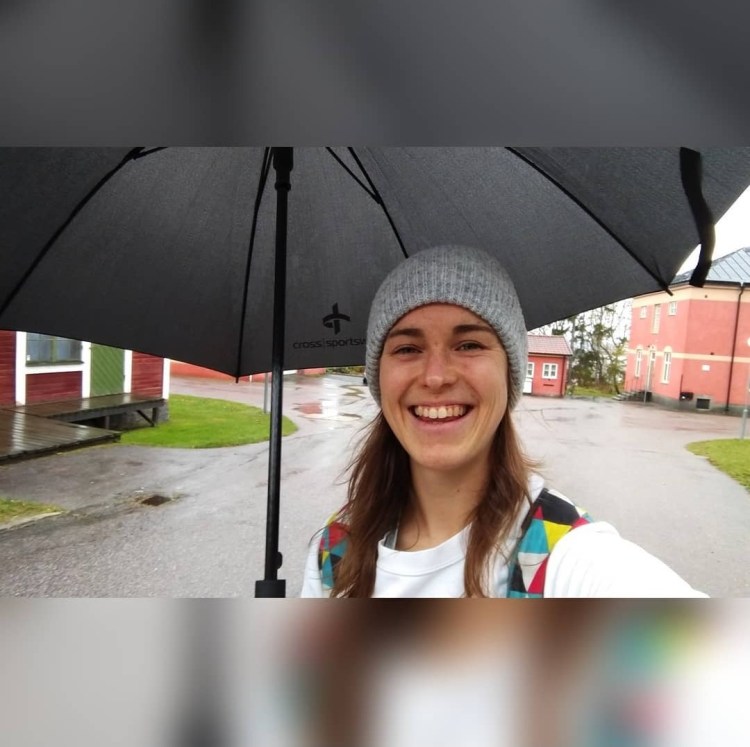
I would describe myself as a serious person, meaning that I am engaged with my own passions.
One of my earliest memories brings me back to the time when I was a child. From my very beginning, I got fascinated about discovering the world. I was always asking questions and wondering about how the things worked. Maybe I became too tough too soon, and at the age of five, I was given a book, which definitely settled my curse. This book, entitled The why of things?, gave an answer to many of my curiosities, but also, brought me new ones.


I realised that reading was a powerful tool to access the knowledge that would help in order to better understand the phenomena around (little) me. However, the more I nurtured my database, the more questions arised, setting the adventure more and more complex. I realised that my toolbox needed an upgrade, and Mathematics came to play. The combination of both worlds, Mathematics together with the observation of Nature, converged to one way: Physics.
As a BSc. student, Quantum Physics was for me an actual revolution. I guess that this happens to any adventurer attracted to novel phenomena. The existence of a playground, where the rules are no more the ones we are used to playing with, crystallised when I discovered the mesoscopic scale. The nano-regime connected this ideal world of quantum tunneling, color shifts and spins to our macroscopic world via astonishing applications. Again, it was straightforward for my passions to end up in the Magnetic field, where the Quantum Nature of materials is at the basis of the spin dynamics that gives rise to magnetic phenomena.
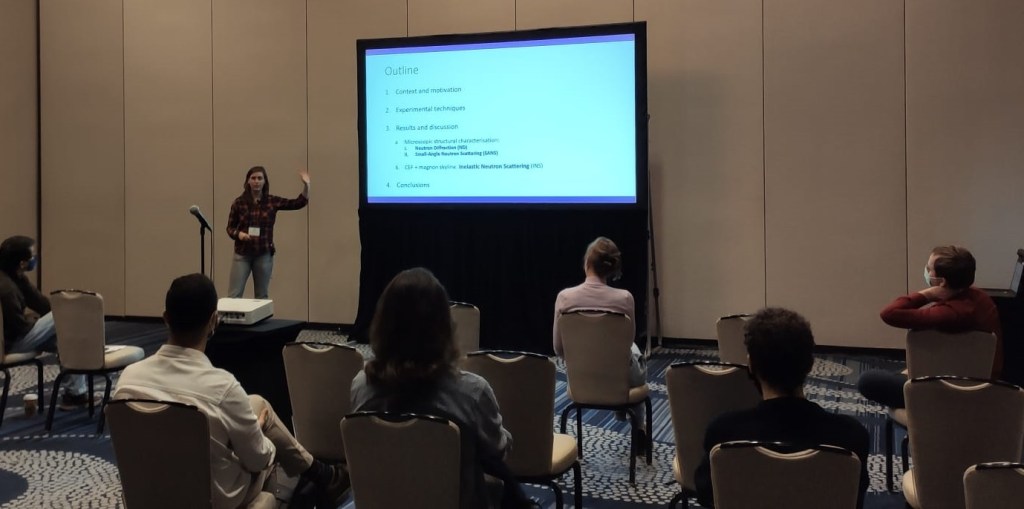
In November 2021 I earned the PhD. in Science and Technology, under the supervision of Professor Luis Fernández Barquín at the Universidad de Cantabria. The Thesis work, entitled «Spin Dynamics in magnetic nanoparticles», was focused on the determination of the magnetic (exchange) interactions among the magnetic moments in nanoparticles. The use of neutron-based experimental techniques (ND, SANS, INS) was extensive, as it allows to access the microscopic magnetic structure, aswell as single-ion and collective magnetic excitations.


The Thesis was awarded with the «Best Thesis Award in Magnetism, Magnetic Materials and their applications» by the Spanish Chapter of the IEEE-Magnetics Society, with the «Juan María Parés» award, from the Consejo Social of the University of Cantabria, and «Premio Extraordinario» from the University of Cantabria.
Meanwhile, I also became fascinated about the possibilities enabled by the manipulation of the electron spin. Furthermore, the existence of topologically-protected spin textures attracted particularly my attention, as they were source of new Physics phenomena and forefront applications. Aiming to learn more about it, I decided to focus my Postdoctoral research on trying to understand the Physics giving rise to these intriguing phenomena.
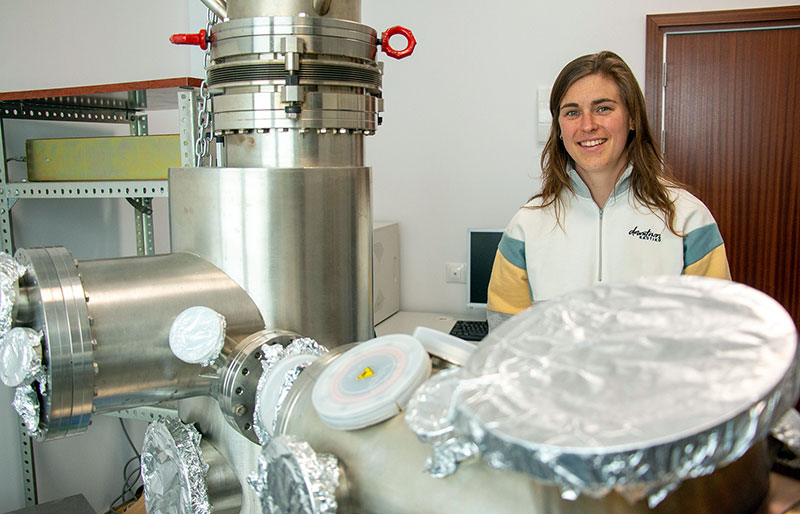
As such, between October 2022 and July 2024, I joined the groups of Prof. Dr. Jairo Sinova and Prof. Dr. Mathias Kläui as an Alexander von Humboldt Postdoctoral fellow to investigate alternative mechanisms to stabilize 3D spin textures in nanostructures, helping to the experimental realization of these magnetic solitons. A lot of hours, days and nights, invested in mastering magnetron sputtering, Kerr Microscopy, Magnetic Force Microscopy, and learning the physics underneath topological structures, advancing my knowledge in nanomagnetism. Eventually getting some hands into micromagnetic modelling!

After gathering all this knowledge on spin disorder phenomena at the nanoscale, I decided to implement it to biomedical applications. As such, I joined in August 2024 the Nanomag group of Prof. Andreas Michels at the University of Luxembourg as a Marie Curie-YIA fellow to develop my project «HYPUSH», where we aim to resolve the magnetic microstructure of iron oxide nanoparticles to connect their internal spin disorder to their excellence heating performance. The project relies on the combination of micromagnetic simulations and experiments, namely, small-angle neutron scattering. Following an intensive training, also supported by Prof. Jonathan Leliaert, from the University of Ghent, we are diving to the core of the nanoparticles and starting to understand why nanoflowers (and similar configurations) heat so well!

My lifegoal, still nowadays, does not differ a lot from the one I had as a child. Nurturing my inner curiosity is the power that pushes me forward, day by day.
 Elizabeth M Jefremovas